Daniel Thalheim
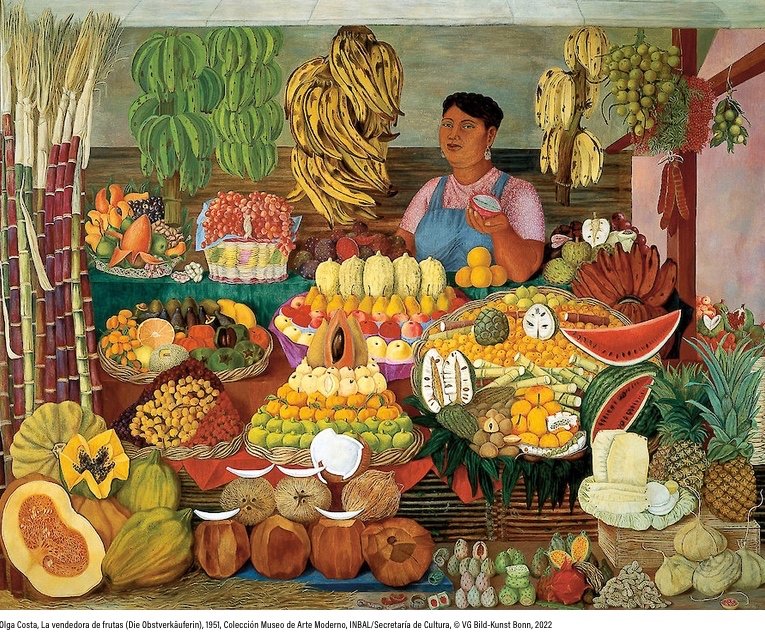
The Museum der Bildenden Künste is in for a surprise as the year draws to a close. In its reflections on Leipzig’s Classical Modernism, the curators‘ focus opens to Mexico. In the cone of light is a Ukrainian woman who was born in Leipzig 110 years ago. Now her pictorial works are returning to Leipzig as part of an exhibition. The limited visit of these pictures might surprise the Leipzigers again. After all, Olga Costa is considered an outstanding national artist in Mexico.
Who is Olga Costa?
In this country, Olga Costa is hardly known. In Mexico she is mentioned in the same breath as Diego Riviera and Frida Kahlo. The fact that she was born in Leipzig is all the more surprising. Her life story alone is enough material for a full-length feature film.
Her parents fled the pogroms that took place in Russia before the outbreak of the First World War to the trade fair city. Berlin eventually becomes the family’s springboard to Mexico. For the father, the composer and violinist Jakob Kostakowsky radicalized himself with communist ideas of Rosa Luxemburg, among others. This was not healthy in imperial Germany. Emigration to Mexico seems like an escape when against this background stands an arrest resulting in death. Kostakowsky was to be sentenced to death.
As the new Museum of Fine Arts exhibition volume reveals, Leipzig-born artist Olga Costa (1913-1993) established herself as one of the most important female voices of Classical Modernism. She connected with the art scene there shortly after her arrival.
Throughout her life she was fascinated by the colors of the Latin American landscape, the scenes of everyday life, Central American culture, and not least by the people themselves. In her paintings, drawings and prints, Olga Costa combines an independent, modern vocabulary with subtle undertones of content. From a specifically female perspective, her works humorously and thoughtfully always reflect on themes such as freedom, belonging, cultural identity, and gender roles.
The path to painting
Costa was one of several important and outstanding female artists in 20th century Mexico, along with María Izquierdo, Lola Cueto and Helen Escobedo. She studied only briefly at the Academy of San Carlos, beginning to paint only in 1936, „as a game,“ as she said, with no intention of doing so professionally. She took this step when she followed her husband José Chávez Morado to Xalapa, Veracruz, to open a painting school and paint the halls of the teaching staff. Chávez Morado encouraged her to experiment.
Costa quickly emancipated herself in Mexico’s cultural and intellectual scene, where she befriended the owner of the Galería de Arte Mexicano, Inés Amor. Amor first invited Costa to exhibit her work in 1945. In 1948, 1950, 1962 and 1971 followed other large solo exhibitions in the same gallery. Amor was also the first to send Costa’s works to the United States. Other solo exhibitions were held at El Cuchitril Gallery (1954), Galería de Arte Contemporáneo (1955), Centro Cultural Ignacio Ramírez in San Miguel Allende (1965), Instituto Cultural Mexicano-Israelí (1969), Galería de Arte in Monterrey (1969), at the Salón de la Plástica Mexicana (1950, 1963, 1972, 1983), at the Galeriá de Arte Contemporáneo (1974, 1975), the Alhóndiga de Granaditas (1975), Galería Lourdes Chumacero (1977), at the Palacio de Bellas Artes (1979) and during the Festival Internacional Cervantino (1985, 1986). In addition, there were various group exhibitions, prizes, stage design commissions, exhibition participations, monographs and honors.
The exhibition at MdbK
The exhibition about Olga Costa’s rich and varied work will be a small sensation. For the first time in Europe, the MdbK will present Olga Costa’s (1913-1993) diverse œuvre in a comprehensive exhibition. In addition to works from over fifty creative years of the artist, outstanding positions of Mexican modernism, such as Frida Kahlo, Diego Rivera, María Izquierdo, Rosa Rolanda or Lola Cueto, will also be on display. The exhibition is crowned by a companion volume titled „Dielogues with Mexican Modernism“, the first serious and comprehensive publication in over 24 years, where she and her work are mentioned, summarized and analyzed.
The Museum Of Pictoral Arts in Leipzig with the Exhibition of Olga Costa
 Artefakte
Hinterlasse einen Kommentar